

First published in The Hindu, 23 Feb 2026
While fragmented and dwindling attention spans are often discussed nowadays, another human quality, that is also on the wane, receives far less attention. I’m referring to the old-fashioned virtue of patience, or simply the willingness to wait without getting flustered. Just as devices have squandered our ability to focus, they have also perpetuated a need for constant stimulation, which in turn, makes us antsy and impatient when we have to wait, take turns or simply have nothing to do. And, this is evident even as we interact with our devices. How many of us get irked when a website is slow to load?
In an article on Psyche, Matt Huston unpacks the psychology of impatience. He cites a study conducted by Annabella Roberts and Ayelet Fishbach that examined people’s impatience as they waited in diverse contexts. These involved knowing the results of the 2020 US presidential election, the first public release of the COVID-19 vaccine and simply waiting for a bus to arrive. In the first two scenarios, people’s impatience escalated the closer they seemed to getting what they were waiting for. Likewise, for those waiting for a bus, their impatience increased if they thought the bus was just about to arrive, even if they hadn’t been waiting for very long.
Desire to finish
The researchers attribute this “swelling impatience” towards the “end of the wait” to people’s desire to finish an activity and move on to the next. You might have experienced this “goal-gradient-effect” when you were completing a lengthy report or taking part in a race. When the end is in sight, you are motivated by a burst of energy to get the job done. However, when you are simply waiting for a bus or a table at a restaurant, there’s not much you can do to accelerate things. So, your “eagerness to act” or “get closure” gets transmuted into a restless energy that’s called impatience.
Effect on health
Experiencing impatience on a regular basis has tangible effects on our health. Professor RJ Starr writes on a blog post on his website that chronic impatience increases your “risk for hypertension and cardiovascular issues.” Further, it can hamper our relationships with people. If you signal irritation, as a friend hems and haws before getting to the point, you may exacerbate your friend’s stress and miss out on the opportunity to have a meaningful exchange.
RJ Starr believes that technological shifts and our dependence on devices have contributed to our rising impatience. Because we are now used to getting things at the click of a button, be it information or entertainment, our capacity to wait has eroded. As e-commerce has also expedited the shopping process, we get antsy if a pizza is not delivered within the stated time window.
Recently, the Indian government put a stop to the 10-minute delivery option on e-commerce websites in the interests of the safety of gig workers who went on strike in December 2025. With e-commerce growing at a rapid rate, companies lure customers with shorter and shorter delivery windows, which are a reflection of our growing impatience.
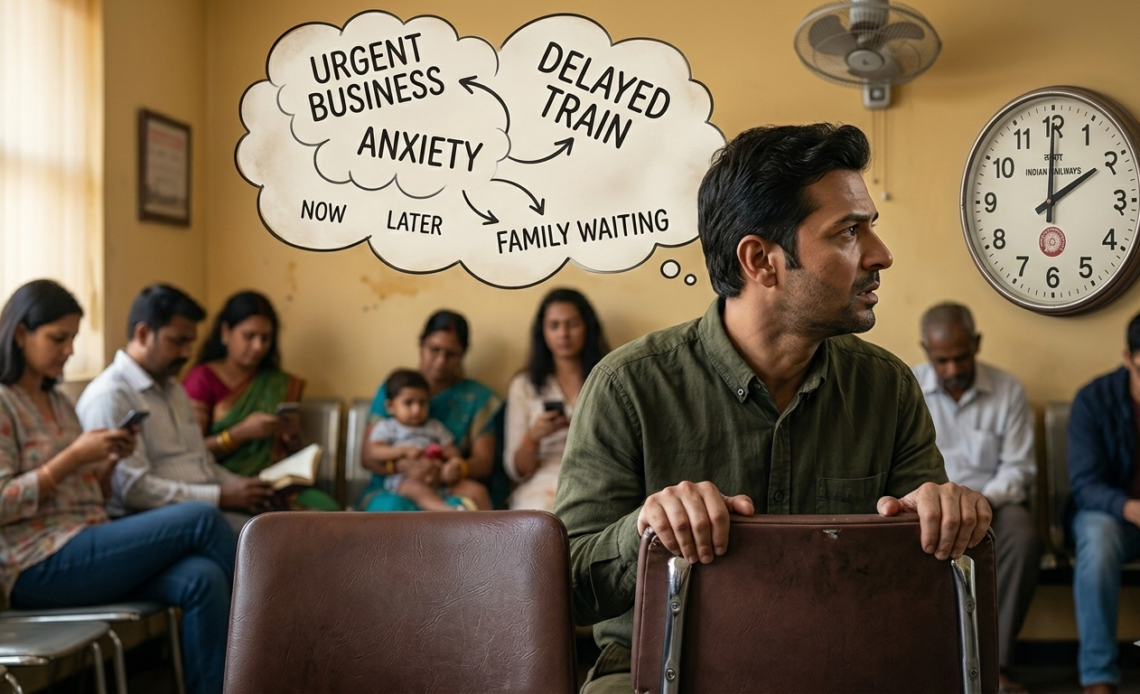
Observe any public space where people are waiting. Whether it’s a bus stop or a doctor’s clinic, people dish out their phones and are tethered to their devices. As a result, we don’t have blank spaces in our lives, when we simply do nothing. As Professor RJ Starr recommends, when we have a spare moment, we may desist from the urge to immediately pick up our phones, which now serve as adult pacifiers. Instead, allow yourself to practice mindfulness or gratitude or simply observe the sights, sounds and smells that surround you. Cultivating patience fosters “emotional resilience,” says Prof Starr. He also reminds us that patience is a choice we can exercise, both in mundane and momentous moments.
The writer is visiting faculty at the School of Education, Azim Premji University, Bengaluru, and the co-author of Bee-Witched.