

Aruna Sankaranarayanan
First published in Deccan Herald, 6 Oct 2026
When I was in school over thirty years ago, Civics was one of the dullest and driest subjects. Learning was limited to spewing back content from the textbook that failed to engage or connect with lived experiences of students. While Civics has been largely subsumed under Social Science nowadays and textbooks address contemporary issues, classes are still mainly teacher-led with scoring marks being the main focus. Fortunately, a more active, constructive and participatory approach to civic education is being spearheaded by some organizations like the Children’s Movement for Civic Awareness (CMCA) in Karnataka.
According to Priya Krishnamurthy, CEO of CMCA, the flagship program of their organization is the Civic Club that currently runs in schools across four States and in all districts of Karnataka, targeting students of Grades 7 and 8. Running through the academic year, the program focuses on themes such as gender, equality, critical thinking, empathy, diversity, integrity and sustainability.
The program also includes an experiential component where children perform an audit of their schools. Working in teams, the children profile various facets of their school that may include electricity usage, food waste management, infrastructural needs, and transport and commute of students. Students are tasked with identifying aspects that are working well and those that require improvement. So, whether it’s repairing latches on bathroom doors or asking for a drinking water filter, students realize that needs have to be prioritized and solutions need to factor in resource constraints. This exercise teaches students that “rights come with responsibilities,” says Krishnamurthy.
According to Shivkumar, a Social Studies teacher, Morarji Desai Residential School, Bevinahalli, students look forward to the Civic Club period. While teachers find it difficult to get students to pay attention in class, children are eager and enthusiastic participants during the Civic Club activities and discussions. Further, he has noticed that students are more sensitive of discriminatory practices in their communities be it of caste or gender and are motivated to spark change. Students also appreciate the idea that everyone, from a sweeper to the President of a country, has both rights and duties as citizens, and they too as children can be stewards of change.
The ripple effect
Though children first exercise civic awareness within their schools, Krishnamurthy notes that a ripple effect is seen as students begin to notice the need for change at home, their neighbourhood, the wider community and finally the village, town or city. For example, Class 7 children have taken photos of cracked and damaged footpaths, loose electric wires, broken streetlights and overflowing garbage dumps and contacted either BBMP or BESCOM to have the problems fixed. A Class 8 boy called the police to break up a street fight when some boys had ganged up against another student.
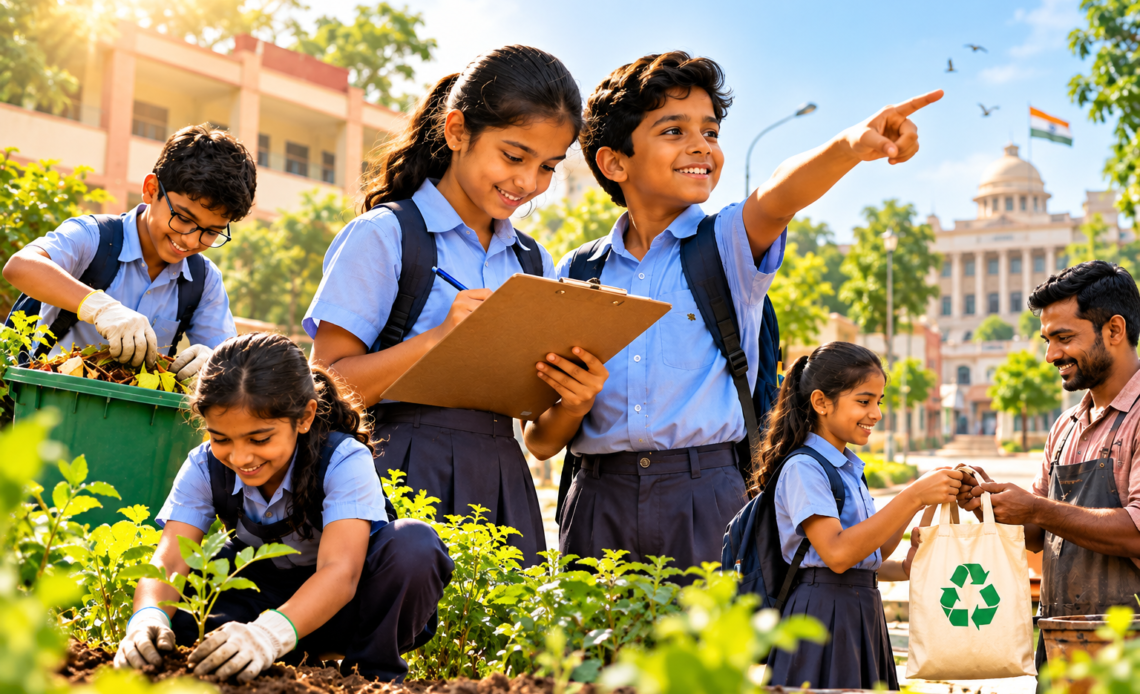
To practice sustainability, students have created compost bins, taken part in park clean-ups and have encouraged friends and relatives to take cloth bags while shopping. A few eighth-graders made newspaper bags in school and distributed them to local vendors to dissuade them from using plastic. In a few instances, children have alerted either the school authorities or the child helpline number 1098 to avert child marriages of peers. Likewise, many children have contacted animal welfare organisations to rescue injured dogs, cats, cows and birds.
CMCA also energises Makkala Grama Sabha across Karnataka. Started in 2006 based on a government order, every year, around Children’s Day, children from rural schools get to voice their issues at a gram panchayat meeting dedicated solely to them. This laudable government initiative, unique to Karnataka, provides children with a platform to advocate their issues. A recent CMCA publication, Makkala Dhwani, documents the tangible impact of children participating in gram sabhas.
CMCA trains volunteers from local communities to be change-catalysts by spreading awareness of civic responsibilities in schools and orienting children on what to expect at such meetings.
To help children understand that not all problems they raise can be tackled immediately, CMCA uses an innovative exercise. They ask students to crumple waste paper into balls and throw them into a bin placed at the centre. Some balls fall right into the bin and represent straightforward issues that can be solved easily. Some paper balls, especially those hurled from a distance, symbolize knottier problems that don’t lend themselves to readymade solutions. However, that doesn’t mean we give up on them. It just means that some issues have to be raised again, which helps children appreciate the importance of persevering if their problems aren’t set right immediately. Further, when the bin gets full, no new problems can be undertaken until the bin is partially emptied. This exercise helps students realize the complexities and challenges of civic engagement without becoming cynical.
CMCA is hoping to take their work to more schools and rural libraries, and beyond schools to apartment complexes in Bengaluru and other cities. Krishnamurthy avers that “education for democratic participation and citizenship” needs to be fostered in schools and homes. While children understand that they are born as citizens of a country, we need to build the disposition and competencies to make them active and engaged participants. The motto of CMCA, “Concern, Cooperate, Coexist, Confront” encapsulates the various dimensions of active citizenship that may be nurtured and championed in children.
(The author is a psychologist, writer & Visiting Faculty, Azim Premji University.)