

Aruna Sankaranarayanan
First published in The Hindu, 6 Sept 2026
As AI continues to leapfrog day on day, educators are grappling with the types of assignments and assessments to give students. Due to rampant cheating using AI, many universities are shifting from long-form research papers to proctored in-person, handwritten exams. Oral exams or viva voces are also making a comeback, so professors can judge whether students actually understand a topic. At the same time, some professors encourage students to use AI for aspects of an assignment, especially when instructors feel a bot can enhance student learning.
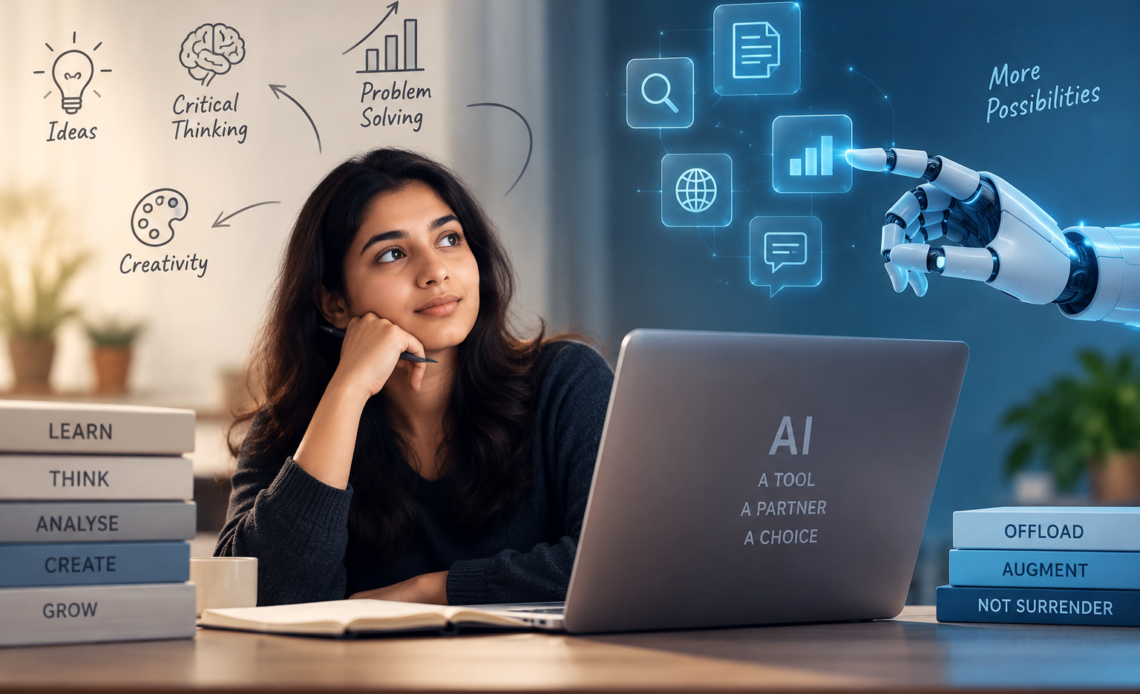
Whether AI promotes or hinders learning depends on how it is used. Used intelligently and responsibly, AI can supercharge learning. Used indiscriminately or with the sole purpose of gaming the system, it can seriously impair human potential. Knowing the difference between cognitive offloading and cognitive surrender can help people use AI with discernment.
Impact of technology
In April, The Economist’s column Bartleby, explained that calculators didn’t make humans “innumerate”. On the contrary, they actually helped individuals enhance their mathematical capabilities. As people didn’t have to waste time and mental effort on tedious calculations, they could focus more on reasoning and problem-solving. Similarly, GPS makes us more efficient as we don’t have to stop and pore over maps or ask strangers for directions. Further, we can also take routes that bypass traffic snarls.
But Bartleby notes that there are costs associated with both technologies. Researchers have found that if calculators are programmed to give incorrect answers, few students are aware of the inaccuracies. More troublingly, a subset of them fail to notice glaringly obvious mistakes. Likewise, an overreliance on GPS is linked with poorer spatial memory.
When it comes to AI, both the benefits and costs of the technology increase exponentially. The term “cognitive surrender” has been coined by Steven Shaw and Gideon Nave to describe what happens when we completely outsource our thinking. In one study, the experimental group were asked to answer challenging questions using AI whereas the control group did the task without assistance. The researchers also deliberately introduced errors into the bot’s answers. When no mistakes were introduced, the group using AI performed better than the control group. However, when AI generated wrong answers, the control group did better. So, when people use AI, they don’t necessarily use their critical faculties.
Impact on creativity
When we interact with AI, we need to be mindful of what aspects of a task we are outsourcing. If we’re becoming more efficient and gaining knowledge and skills, we stand to gain immensely. Many of the bots have a learning mode that facilitates problem-solving and refines your skills. On the other hand, depending on AI to do the thinking for us, puts us at grave risk. Because AI can be wrong, and even fabricate information, we need to be vigilant. In an article in The New York Times (29 June), Noam Scheiber writes that research has found that managers were more negligent when checking for errors in documents created by AI. However, other managers who thought that a human had produced the documents were more thorough and spotted the same mistakes. Whereas we expect humans to make mistakes, most people still think AI is infallible.
Groupthink
What happens when everyone depends on AI for thinking? Scheiber writes that some issues may not be noticeable at the “individual level” but may emerge collectively and over time. Suppose, scientists begin to rely on AI to guide them through every step of the scientific process in their respective domains, from deciding what to study and how. Gradually, all scientists in a field may start thinking alike, stymying creativity in various disciplines.
Even as AI gets more competent and potent, the need for human critical reasoning, discernment and judgment is only going to get stronger.
(The author is Visiting Faculty, School of Education, Azim Premji University & the co-author of Bee-witched.)